Is Marble a Good Kitchen Countertop?
2023-12-22
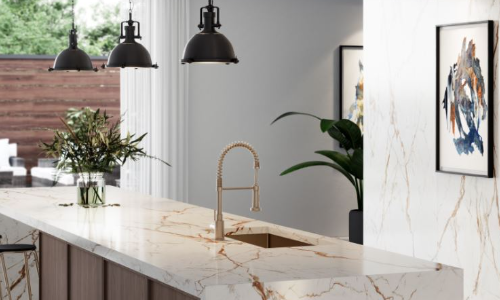
When it comes to selecting kitchen countertops, marble remains the top choice for many homeowners. For ages, the allure of marble countertops, kitchen islands, and backsplashes has been evident, and it's easy to see why. "Marble stands out due to its natural diversity, determined by the specific type you choose and its unique cut. Its inherent patterns are unmatched by most synthetic alternatives." White marble, in particular, garners significant admiration.
High quality marbles are known for their durability and resistance to stains. While marble remains a popular option for countertops, it's essential to recognize that it isn't flawless and comes with its own set of vulnerabilities.
Marble, a non foliated metamorphic rock, primarily consists of calcium carbonate (similar to the component found in antacids like Tums) or magnesium carbonate, both of which can react to acidic substances. Exposing marble to acidic solutions like lemon juice or vinegar can cause etching, resulting in a faded, whitened area on the surface, even if the marble has been treated with a sealant.
However, this shouldn't deter you from considering marble altogether in favor of alternatives like butcher block or quartz countertops. Instead, it emphasizes the importance of making an informed decision, understanding the material's characteristics, and learning how to maintain its beauty. Whether you're drawn to black or white marble countertops, they can serve as a timeless and elegant choice for your kitchen, provided you care for them correctly.
To assist you in your kitchen marble counter top journey, we've compiled nine expert recommendations on selecting the ideal marble slab and addressed some frequently asked questions. So, if marble countertops are on your radar, consider this your comprehensive guide.
9 Tips for Choosing a Marble Counter Top
If you’re concerned about stains, stick with white marble.
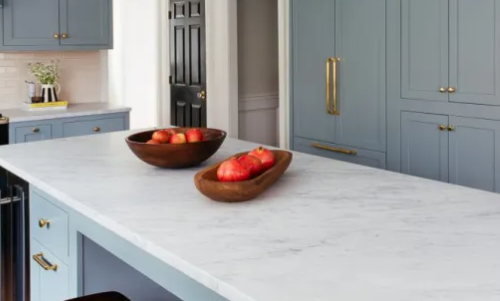
While creamy white marble often comes to mind for many, marble boasts a vast spectrum of varieties. These range from taupe and green to gold, red, and even black. When considering marble for kitchen countertops, it’s a good advice opting for white marble. The reason being, acid etching is more conspicuous on colored marble compared to its white counterpart.
Although classic Italian white marbles are widely recognized for their quality and are popular choices for kitchens, equally superior marbles can be sourced closer to home.
Consider how the different marble slabs will come together.
Each stone slab possesses its unique characteristics, making it essential to handpick the specific pieces intended for your countertops.
Simultaneously, the cohesion of different pieces is crucial. Opt for longer pieces to minimize seams whenever possible. However, if seams are unavoidable, there is a technique known as book matching. This method ensures that adjacent marble pieces align in such a way that their patterns reflect each other, creating a harmonious mirrored effect.
Take veining patterns into account.
While each quarry offers its distinct characteristics, there's a technique to cut specific marble blocks in two distinct manners, producing varied veining patterns. The cross cut, also known as fleuri cut, produces stone slabs with an "open flowered pattern." This pattern appears quite spontaneous and is particularly suitable for book matching techniques. On the other hand, the vein cut, or striato, involves slicing the block differently, resulting in a linear and striped aesthetic.
You can transform the look of marble with different finishes.
Today, there's a broader range of stone finishing techniques available, encompassing various brushing and polishing methods. One can achieve textures reminiscent of an orange peel, often referred to as leather, brushed, or river wash finishes.
However, polished and honed finishes continue to dominate preferences. A polished finish boasts a shiny appearance, while a honed finish presents a matte look. For homeowners wary of acid etching, a honed finish is recommended. With a polished surface, etching would diminish its luster and become more evident. In contrast, on a honed finish, any etching would blend into the already subdued surface, making it less noticeable.
Consider curving the edges of your kitchen counter top.
Marble's longstanding appeal for sculptures isn't just about its aesthetic allure; it's also because of its workability with various tools. When you factor in advanced computer numerical control milling machines, the possibilities for kitchen decor become virtually limitless.
While there's a myriad of edge profiles available, Groves leans towards a straightforward eased edge, softening the sharpness of a typical 90 degree corner. Cherrington highlights the enduring popularity and practicality of a bull's nose edge, resembling a semi circle.
Call the marble facility ahead of your visit.
Before visiting a marble slab facility, it's advisable to contact them ahead of time. Discuss your specific needs, including the desired color, type, required square footage, and dimensions of the marble slabs you're looking for. This ensures they can accommodate your requirements and streamline your selection process.
Know the difference between cracks and fissures in your marble.
Cracks are a sign that the marble has been dropped or improperly handled. Fissures, though, are entirely different.
Ask about the origin of the marble.
White marbles like Calacatta and Statuario are experiencing significant popularity at present. Consequently, certain marble suppliers might label their veined white marble as "Calacatta" marble. However, it's essential to note that these may not be genuine Calacatta stones; instead, they could be white marbles with veins sourced from regions like China or other parts of the globe.
Maintain your marble countertops by getting a sealed finish.
Applying a penetrating sealer to white kitchen countertop is crucial to ensure their durability over time. Maintaining a polished marble surface demands specific abrasives and expertise, making professional cleaning advisable. However, it's important to note that such treatments will also remove the protective sealer. Therefore, after any restoration work, reapplying the sealer becomes imperative.
The good thing about marble is that you can always sand it down or polish it again; with a lot of other materials, once you damage it, you can’t do that.
What Are The Benefits of KERB Stone?
What Is A Outdoor Garden Statue?
Related Article

Natural stone and manufactured cultured stone are the two most popular types of stone veneers on the market.
Key Differences Between Cultured Stone And Natural Stone

If you're looking for a unique and striking take on marble tiles, our onyx tiles collection might be just what you need.
What Are Onyx Tiles?